
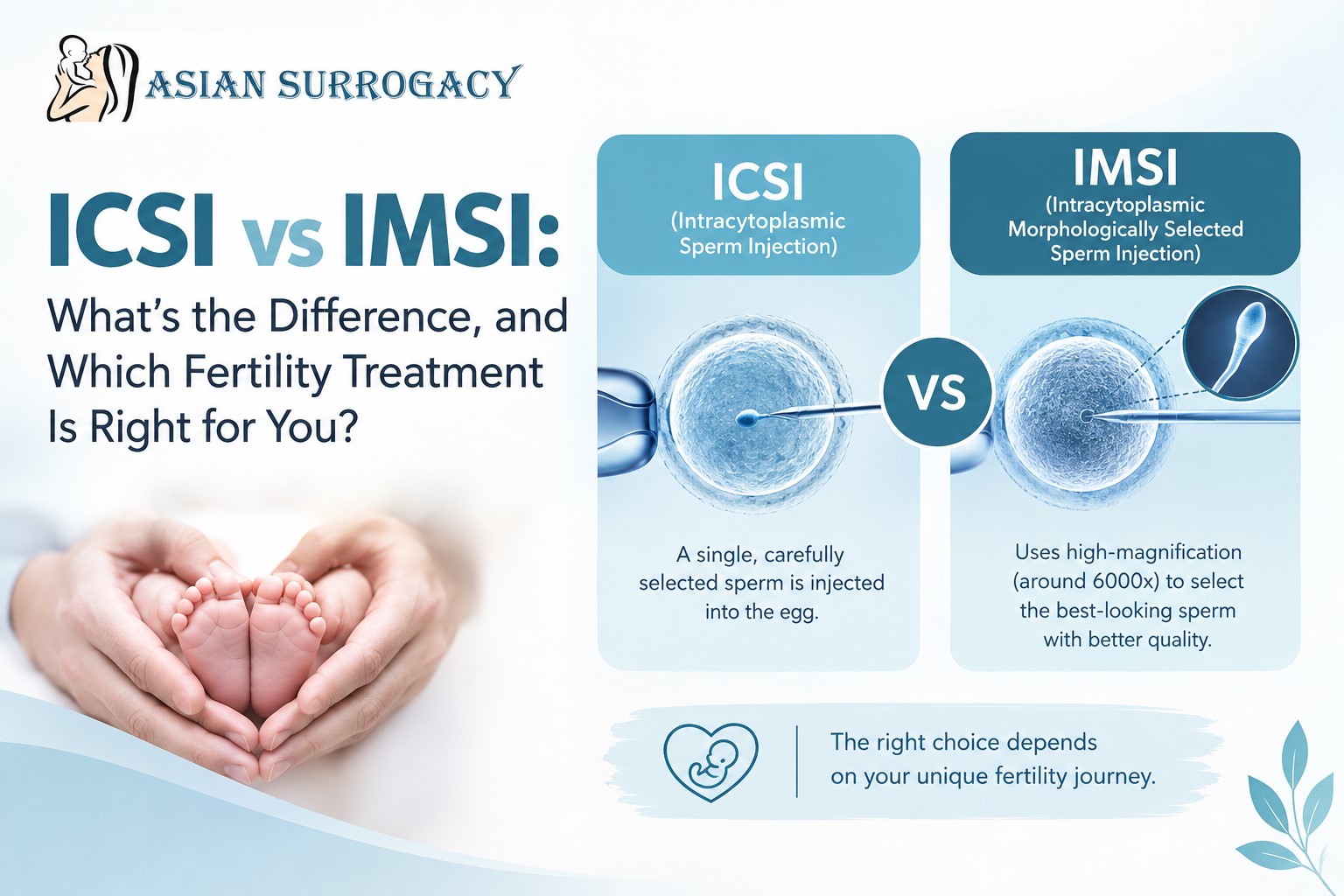
ICSI vs IMSI: What’s the Difference, and Which Fertility Treatment Is Right for You?
When couples are exploring fertility treatment, they may come across several assisted reproductive techniques, including IVF, ICSI, and IMSI. Two techniques that are often compared are ICSI vs IMSI , particularly when male-factor infertility or concerns about sperm quality are involved.
But what is the ifference between ICSI and IMSI? Is IMSI simply a more advanced form of ICSI? And when comparing ICSI or IMSI which is better , how does a fertility specialist decide which technique may be appropriate?
The answer depends on the couple's individual fertility history, sperm characteristics, previous treatment outcomes, and the fertility specialist's assessment.
What Is ICSI Treatment?
ICSI treatment, or Intracytoplasmic Sperm Injection, is an assisted reproductive technique commonly performed as part of IVF.
During ICSI, an embryologist selects a sperm cell and directly injects it into a mature egg using specialized laboratory equipment. The objective is to help the sperm fertilize the egg when natural fertilization may be difficult.
ICSI may be considered in situations such as low sperm count, poor sperm movement, abnormal sperm morphology, previous fertilization problems, or certain cases involving surgically retrieved sperm.
Who Needs ICSI?
Patients may be considered for ICSI when there are significant male-factor infertility concerns or when previous IVF treatment resulted in poor or failed fertilization.
However, who needs ICSI should not be determined by a single sperm parameter alone. A fertility specialist generally considers the complete clinical picture before recommending the procedure.
What Is IMSI Treatment?
IMSI treatment, or Intracytoplasmic Morphologically Selected Sperm Injection, is a laboratory technique that involves selecting sperm under much higher magnification before injection into the egg.
The main difference is the level of sperm examination. IMSI allows embryologists to examine sperm morphology in greater detail before selecting a sperm for injection.
This is why IMSI fertility treatment may be discussed for some couples with specific sperm-quality concerns or previous treatment history.
IMSI IVF treatment is performed in conjunction with an IVF cycle rather than being a completely separate form of IVF.
ICSI vs IMSI: What Is the Difference?
The main ICSI vs IMSI difference is how the sperm is examined and selected before injection.
With conventional ICSI, sperm are selected using standard laboratory microscopy. With IMSI, sperm are examined under higher magnification, allowing the embryologist to assess certain morphological characteristics in greater detail.
Therefore, IMSI vs ICSI is primarily a comparison of sperm-selection techniques rather than two completely different fertilization processes.
ICSI or IMSI: Which Is Better?
One of the most common questions patients ask is, “ICSI or IMSI which is better?”
There is no single answer that applies to every couple.
IMSI gives a more detailed check of sperm shape. But it is not always better for every IVF patient. How useful IMSI is depends on sperm quality and past IVF results. It also depends on lab protocols and the fertility specialist’s advice.
When discussing ICSI vs IMSI which is better, couples should ask why a technique is advised. They should not assume newer or advanced methods always give better results.
ICSI vs IMSI Success Rate
Another important search question is ICSI vs IMSI success rate.
Fertilization, embryo development, implantation, and pregnancy outcomes can vary considerably between patients. Factors such as female age, egg quality, sperm quality, embryo quality, ovarian reserve, infertility diagnosis, and the fertility laboratory can all influence outcomes.
Some studies have looked at whether IMSI gives better results than standard ICSI in some patient groups.
However, evidence has not shown that IMSI is always better than ICSI.
For this reason, patients should be careful with clinics or websites. Some may promise a specific IMSI success rate or ICSI success rate. They may not explain the patient group or the outcome they are measuring.
A fertility specialist can provide more meaningful information based on an individual's medical history and treatment plan.
ICSI vs IMSI Cost
The ICSI vs IMSI cost can differ between fertility clinics because IMSI may require additional laboratory equipment, technology, and embryology procedures.
In general, the total treatment cost can include several components, such as:
- Fertility consultations
- Ovarian stimulation medicines
- Monitoring and scans
- Egg retrieval
- Laboratory procedures
- ICSI or IMSI procedure
- Embryo culture
- Embryo transfer
- Additional laboratory services
Therefore, IMSI treatment cost should not be considered separately from the overall IVF treatment cost.
Similarly, ICSI treatment cost can vary depending on the clinic, medicines, investigations, laboratory services, and individual treatment requirements.
Patients should ask the fertility clinic for a complete cost estimate rather than comparing only the procedure fee.
IMSI for Male Infertility
IMSI for male infertility may be discussed when sperm quality is a significant concern.
Male infertility can involve several factors, including:
- Low sperm concentration
- Poor sperm motility
- Abnormal sperm morphology
- Previous poor fertilization
- Certain sperm production disorders
- Problems requiring surgically retrieved sperm
However, IMSI is not automatically required whenever male infertility is diagnosed. A fertility specialist and embryology team may determine whether detailed sperm selection could be relevant in a particular case.
ICSI for Male Infertility
ICSI for male infertility is common in assisted reproduction. It lets a chosen sperm be injected directly into an egg.
This can help when sperm cannot fertilise an egg naturally.
The choice to use ICSI may depend on semen analysis results. It may also depend on past IVF outcomes. It can depend on the number and quality of available eggs. Other fertility factors may also affect the decision.
Who Should Choose IMSI?
So, who should choose IMSI?
IMSI may be considered in selected situations where the fertility team believes detailed sperm morphological assessment could be useful. The decision may take into account sperm characteristics, previous fertilization or IVF outcomes, and the clinic's laboratory protocols.
It is important to understand that IMSI is not automatically necessary for every patient undergoing IVF or ICSI.
ICSI vs IMSI: Which One Should You Discuss With Your Fertility Specialist?
The decision between ICSI and IMSI should be individualized.
If sperm quality is a concern, ask your fertility specialist and embryologist:
“What is the reason for recommending ICSI or IMSI in my case?”
You can also ask:
- What does my semen analysis show?
- Have I had previous fertilization problems?
- Would detailed sperm selection be useful in my situation?
- What are the expected benefits and limitations?
- What is included in the treatment cost?
- What outcomes does your fertility centre usually monitor?
These questions can help you understand why a particular laboratory technique is being recommended.
ICSI vs IMSI: Key Takeaway
The main difference between ICSI and IMSI is the way sperm are examined and selected before injection. Both techniques involve injecting a selected sperm directly into an egg, generally as part of an IVF cycle.
ICSI treatment is a well-established technique used in many fertility treatment situations, particularly where fertilization may be difficult. IMSI treatment uses higher-magnification sperm assessment and may be considered in selected cases.
When comparing ICSI vs IMSI, no single option suits every patient. Your fertility specialist can recommend a method based on your reproductive history. They will also review sperm and egg features. They may consider past treatment results. They will also consider your personal treatment goals.
Frequently Asked Questions
Is IMSI better than ICSI?
IMSI is not automatically better than ICSI for every patient. It provides more detailed sperm morphological assessment, and its potential usefulness depends on the individual clinical situation.
What is the main difference between ICSI and IMSI?
Both involve injecting sperm directly into an egg. The major difference is the level of magnification used for sperm selection before injection.
Is IMSI part of IVF?
Yes. IMSI IVF treatment is performed as part of an IVF cycle and focuses on detailed sperm selection before injection.
Is ICSI used for male infertility?
Yes. ICSI for male infertility may be recommended in several situations involving sperm count, motility, morphology, or previous fertilization problems.
How much does IMSI cost?
The IMSI treatment cost varies by fertility centre and by the medicines, investigations, laboratory procedures, and other services included in the IVF cycle.
Does IMSI guarantee a higher success rate?
No fertility treatment can guarantee pregnancy or a live birth. The expected outcome depends on multiple factors, including age, egg quality, sperm quality, embryo quality, infertility diagnosis, and laboratory factors.
Final Thoughts
Choosing between ICSI and IMSI is not simply about selecting the most advanced-sounding technology. It is about understanding the fertility factors involved and choosing a treatment approach that is appropriate for the individual couple.
If you are considering IVF, ICSI, or IMSI, discuss your medical history and laboratory findings with a qualified fertility specialist before making a treatment decision.