
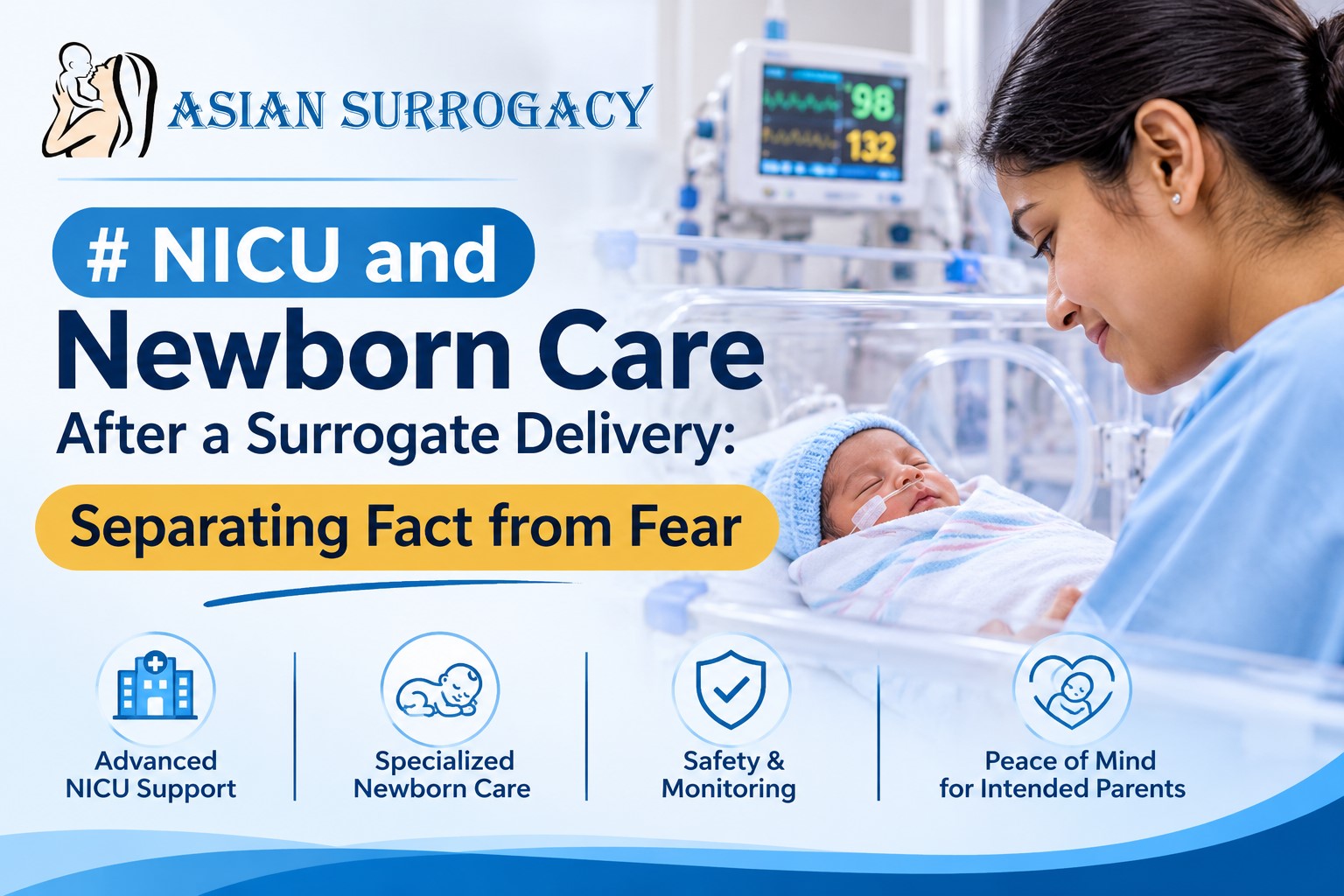
NICU and Newborn Care After a Surrogate Delivery: Separating Fact from Fear
The moment your baby is born through surrogacy is a life-changing miracle. However, for some families, the first few days aren't spent in a standard maternity suite, but in the Neonatal Intensive Care Unit (NICU).
At Asian Surrogacy , we understand that NICU admission can be overwhelming. This guide is designed to walk intended parents through the medical processes, essential screenings, and bonding opportunities that occur after a surrogate delivery.
1. Why Do Surrogate Babies Need NICU Care?
Some babies born through surrogacy may require care in a Neonatal Intensive Care Unit (NICU). This can be due to factors such as multiple pregnancies, premature delivery or medical complications during birth.
Common reasons for NICU admission include:
- Prematurity: Babies born before 37 weeks of pregnancy may need additional monitoring and specialized care.
- Respiratory Distress: Some newborns require breathing support or supplemental oxygen to maintain healthy oxygen levels.
- Jaundice: Elevated bilirubin levels may require treatment through phototherapy.
- Medical Observation: Babies may need close monitoring following a complicated delivery or because of other medical concerns.
Pro Tip : A NICU stay does not necessarily mean something is seriously wrong. It means your baby is receiving specialized medical attention and monitoring to support their health and development.
2. The First Hour: Apgar Scores and Newborn Assessment
Immediately following a surrogate delivery, the medical team performs an Apgar assessment at one minute and five minutes after birth.
This assessment helps healthcare professionals evaluate the newborn's immediate physical condition through five observations:
- Appearance: The baby's skin colour.
- Pulse: The baby's heart rate.
- Grimace: Reflex response to stimulation.
- Activity: Muscle tone and movement.
- Respiration: Breathing effort and respiratory response.
Each category receives a score from zero to two, giving a total score out of ten. A score of 7 or above is generally reassuring. If the score is lower, the medical team evaluates the baby and provides appropriate support when needed.
The Neonatal Intensive Care Unit (NICU) team may step in if the newborn requires additional monitoring or medical assistance.
3. Comprehensive Newborn Screening Tests
Before your baby is discharged from the hospital, doctors may recommend several routine and specialized newborn screening tests. These assessments help identify certain health conditions early so that appropriate treatment can begin when necessary.
The Bloodspot (Heel Prick) Test
The heel prick test involves collecting a small blood sample from the baby's heel. It is generally performed during the first 24–48 hours after birth, depending on the hospital protocol.
This screening can help identify certain metabolic, endocrine and genetic conditions, including phenylketonuria (PKU), congenital hypothyroidism and, where included in the screening panel, cystic fibrosis.
Hearing Screening
Newborn hearing screening is a non-invasive test used to identify possible hearing difficulties at an early stage.
Depending on the hospital's protocol, tests such as Otoacoustic Emissions (OAE) or Automated Auditory Brainstem Response (AABR) may be performed.
Early identification of hearing difficulties can support timely intervention and healthy language development.
Critical Congenital Heart Disease (CCHD) Screening
Critical Congenital Heart Disease screening commonly uses pulse oximetry to measure oxygen levels in the baby's right hand and one foot.
This test can help identify certain serious heart conditions that may not be immediately apparent after birth. If the results are abnormal, doctors may recommend further investigations and appropriate medical treatment.
4. The Intended Parent's Role in the NICU
Many intended parents have an important question: "Can I hold my baby if they are in the NICU?"
In many cases, yes. Parents can participate in their baby's care, depending on the newborn's medical condition and the hospital's visitation and infection-control policies.
- Kangaroo Care: Skin-to-skin contact, when medically appropriate, can help support the baby's temperature regulation, heart rate and bonding with parents.
- Feeding: Parents may participate in feeding through breastfeeding, expressed breast milk, formula or other methods recommended by the medical team. If you are inducing lactation for breastfeeding, discuss suitable feeding arrangements with your healthcare team.
- Medical Decision-Making: Intended parents should understand their legal responsibilities and the hospital's procedures for consent and medical decision-making. Appropriate legal documentation may be required.
Being involved in your baby's daily care can help build confidence and strengthen the emotional bond during the NICU journey.
5. Criteria for NICU Discharge
Before your baby can leave the hospital, the medical team evaluates whether the newborn is medically stable and ready for home care.
Some important discharge considerations include:
- Temperature Regulation: The baby can maintain a stable body temperature in an open crib without additional warming support.
- Feeding Success: The baby can feed adequately through the recommended feeding method and demonstrate appropriate weight gain.
- Respiratory Stability: The baby can breathe adequately without additional respiratory support, unless a medically supervised home-care plan is arranged.
- Car Seat Safety: Some premature or medically vulnerable newborns may require a car seat tolerance test before discharge. The duration and criteria depend on the hospital's protocol.
The NICU team will also explain medication schedules, feeding instructions, follow-up appointments and warning signs that parents should monitor after discharge.
6. Frequently Asked Questions: Common Concerns for Surrogate Parents
Will my surrogate have access to the NICU?
NICU visitation policies vary between hospitals. The surrogate mother's access depends on hospital rules, medical considerations and applicable legal arrangements. Intended parents and the surrogate should discuss visitation respectfully with the hospital team.
Are NICU costs covered?
NICU expenses depend on the applicable insurance policy, hospital arrangements and coverage terms. Intended parents should confirm whether newborn medical expenses are covered from birth, including NICU admission, medicines, investigations and extended hospitalisation. Review your surrogacy insurance coverage and newborn insurance arrangements early in the pregnancy.
Why Choose Asian Surrogacy?
Navigating the complexities of newborn care after surrogacy requires an experienced and supportive team. At Asian Surrogacy, we help intended parents navigate important stages of the surrogacy journey by providing:
- 24/7 Hospital Coordination: Assistance with communication and coordination between intended parents and the hospital team.
- Legal and Documentation Assistance: Guidance with birth certificates, hospital discharge paperwork and related documentation.
- Emotional Support: Compassionate support for intended parents and families during challenging NICU stays.