
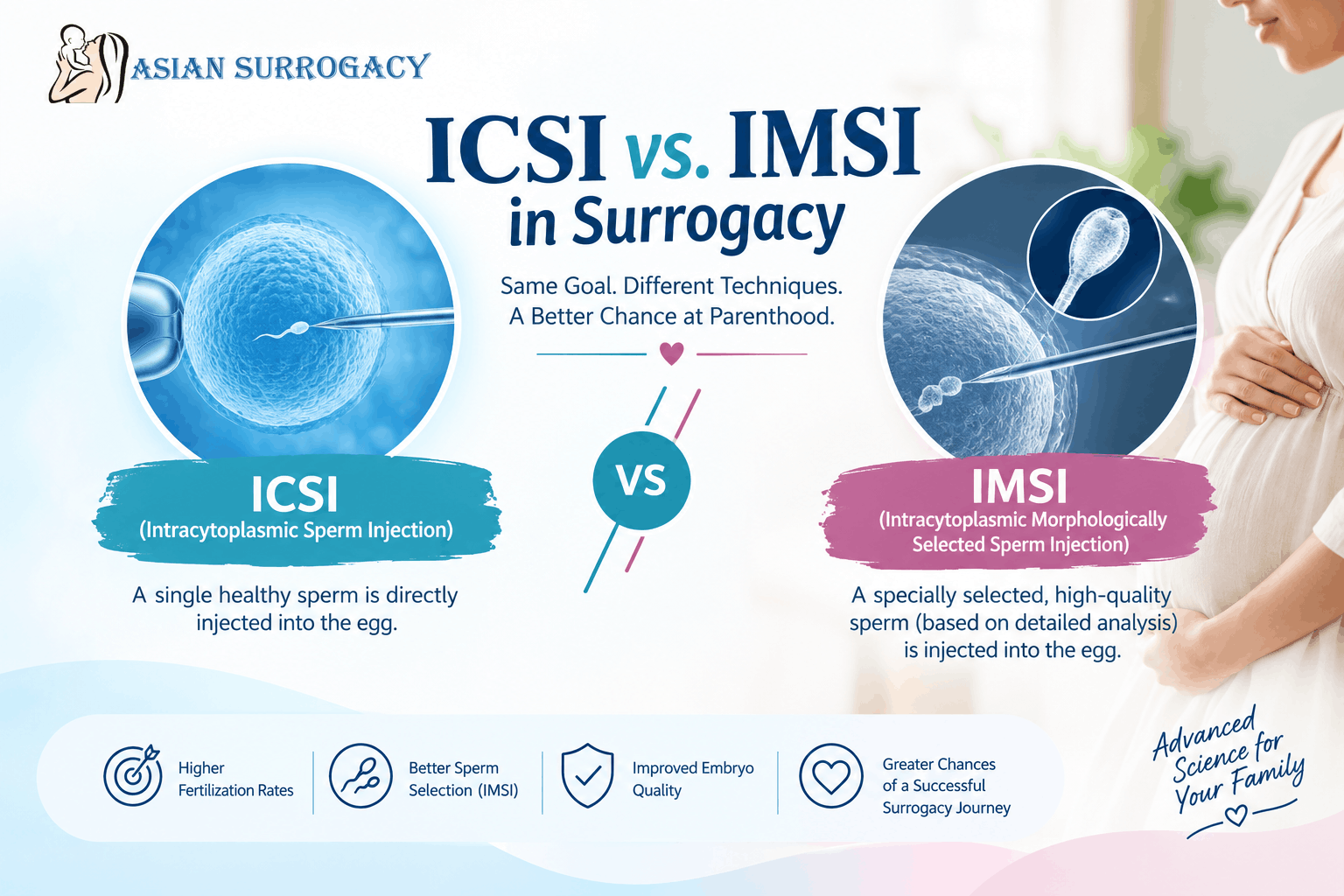
ICSI vs. IMSI in Surrogacy: Choosing the Right Sperm Selection Technique for Your Journey
When navigating the surrogacy journey, every single step in the lab matters. You are investing emotionally, financially, and physically to build a family. Once eggs are retrieved from the intended mother or egg donor, fertilizing them successfully is the first critical milestone.
In traditional IVF, thousands of sperm are placed near an egg in a dish, leaving fertilization to chance. However, in modern surrogacy cycles, advanced lab techniques like ICSI and IMSI are often utilized to ensure the highest possible fertilization and embryo development rates before transferring an embryo to the surrogate.
Understanding the differences between ICSI and IMSI can help you make an informed decision alongside your reproductive endocrinologist.
What is ICSI? (Intracytoplasmic Sperm Injection)
ICSI is a specialized form of IVF designed to treat male factor infertility and optimize fertilization rates. During ICSI, an embryologist isolates a single sperm cell and injects it directly into the center (cytoplasm) of a mature egg using a fine glass needle.
- Magnification Used : Standard lab microscopes zoom in at roughly 200x to 400x magnification.
- Selection Basis : The embryologist selects the best-looking sperm based on general shape (morphology) and movement (motility).
- Common Use Cases : Low sperm count, poor sperm motility, previous IVF fertilization failures, or when using frozen sperm samples.
Because surrogacy journeys involve precious donor or intended parent eggs, ICSI is routinely used in most surrogacy clinics to maximize fertilization success.
What is IMSI? (Intracytoplasmic Morphologically Selected Sperm Injection)
IMSI is an enhanced, high-precision variation of ICSI. The core injection procedure remains identical, but the selection process is vastly superior. Instead of standard microscopy, IMSI uses ultra-high-power digital microscopy to analyze the inner structure of individual sperm cells in real time.
- Magnification Used : Advanced optics magnify sperm up to 6,000x magnification (over 15 times higher than standard ICSI).
- Selection Basis : At this extreme zoom level, embryologists can identify micro-defects—such as tiny head vacuoles (indentations/holes in the sperm head)—that are invisible under standard ICSI microscopes. Sperm head vacuoles often correlate with high DNA fragmentation, which can cause poor blastocyst development or early pregnancy loss.
- Common Use Cases : Severe male factor infertility, high sperm DNA fragmentation rates, recurrent implantation failure in previous surrogacy cycles, or unexplained recurrent miscarriages.
Key Differences at a Glance
| Feature | ICSI | IMSI |
|---|---|---|
| Microscope Magnification | ~200x – 400x | ~6,000x |
| Sperm Evaluation Level | External shape and motility | Detailed internal organelle structures and nuclear defects |
| Primary Goal | Direct fertilization overcoming motility/count barriers | Selecting genetically sound, defect-free sperm for higher embryo quality |
| Lab Time & Cost | Standard ART cost & duration | Higher cost; requires specialized optics and skilled analysis |
| Ideal Candidate | General male factor, frozen sperm, routine surrogacy cycles | Severe teratozoospermia, high DNA fragmentation, repeated surrogacy failures |
Why Sperm Selection Is Critical in Surrogacy
In surrogacy, the surrogate’s uterine environment is usually optimized for implantation. If an embryo fails to implant or leads to early loss, the issue frequently traces back to embryo quality and chromosomal health.
- The Male Factor Contribution : Half of an embryo's genetic makeup comes from the sperm. Sperm with intact DNA structure are far more likely to form robust, day-5 blastocysts capable of achieving a sustained pregnancy.
- Protecting the Surrogate’s Time and Health : Avoiding failed transfers saves both intended parents and gestational carriers from unnecessary hormonal cycles and emotional distress.
- Optimizing Donor Eggs : When utilizing expensive egg donor cycles, using high-definition selection like IMSI guarantees that only the highest quality sperm fertilize the limited number of donor eggs.
ICSI or IMSI: Which Should You Choose?
- Choose ICSI if : You are pursuing a standard surrogacy cycle, male semen parameters fall within or near normal reference ranges, or you are using healthy donor sperm.
- Discuss IMSI with your doctor if : The male partner has elevated sperm DNA fragmentation, a history of poor embryo development despite good egg quality, or multiple unsuccessful IVF/surrogacy attempts.
Every surrogacy path is unique. Consult with your fertility clinic’s embryology team to analyze your semen parameters and decide whether standard ICSI or ultra-magnified IMSI aligns best with your treatment plan.
Here is a Frequently Asked Questions (FAQ) section designed to complement the blog post on ICSI vs. IMSI in surrogacy :
FREQUENTLY ASKED QUESTIONS
Q1: What is the main difference between ICSI and IMSI?
The primary difference lies in the microscopic magnification used during sperm selection. ICSI uses standard magnification (200x–400x) to evaluate a sperm's outer shape and movement. IMSI uses ultra-high digital magnification (up to 6,000x) to assess internal structural details and detect hidden defects like sperm head vacuoles.
Q2: Does IMSI replace ICSI, or are they the same procedure?
IMSI is an advanced variation of ICSI rather than a completely different procedure. The actual injection method—inserting a single sperm directly into the egg's cytoplasm—is identical. The only difference is the high-tech optical selection process before the injection occurs.
Q3: Why is advanced sperm selection important in a surrogacy cycle?
In surrogacy, the surrogate mother’s womb is prepared to provide an ideal environment for implantation. If an embryo fails to implant or leads to early loss, the cause often relates to embryo quality or chromosomal health. Since sperm supplies half of the embryo's DNA, selecting intact, high-quality sperm improves blastocyst formation and reduces transfer failures.
Q4: Is IMSI necessary for every IVF or surrogacy treatment?
No. Standard ICSI is effective for most routine surrogacy and male-factor infertility cases. IMSI is generally recommended when there is a history of severe male factor infertility, high sperm DNA fragmentation, poor embryo development in past cycles, or repeated implantation failures.
Q5: Does IMSI guarantee a successful pregnancy or live birth?
While IMSI improves the chances of selecting genetically sound sperm and creating higher-quality embryos, no laboratory technique can guarantee 100% success. Success also depends on egg quality, surrogate uterine health, and general embryo genetics.
Q6: Is IMSI more expensive than standard ICSI?
Yes. IMSI requires specialized high-magnification equipment, advanced software, and additional laboratory time by skilled embryologists, making it more expensive than standard ICSI.